Six Months Under the Ridge: The Clink Carillon Has Started Answering Back
Six months ago, the ice in Whisperwind Caverns gave up its blueprints and changed the case. Clink, the Frostbitten Bell Collector, no longer looked like a thief hoarding the North Pole’s music. He looked like a bellmaker trying, across weather and fear and one very stubborn century, to finish a storm-carillon meant to bind squalls before they broke roofs, sleigh lines, and courage.
Now the carillon has begun to answer.
Case File
Case ID: WS-CLINK-07-22 Location: Snowfall Ridge, Whisperwind Caverns, Sleighworks Storage Hall Annex Primary Phenomenon: Low-amplitude storm-carillon resonance; returned bell intervals; repeated frost spiral snowprints Status: Active, contained, no public danger at press time
Lead agencies: North Pole Investigative Bureau, Workshop Acoustics, Ice Menders, Sleigh Ops Weather Desk Evidence plates: Snappers Glitterbeard, field negatives WS-CLINK-41 through WS-CLINK-57
The Short Version
The missing sleigh bells have not all come home. That sentence will disappoint anyone who prefers endings tied with ribbon. Investigations rarely do.
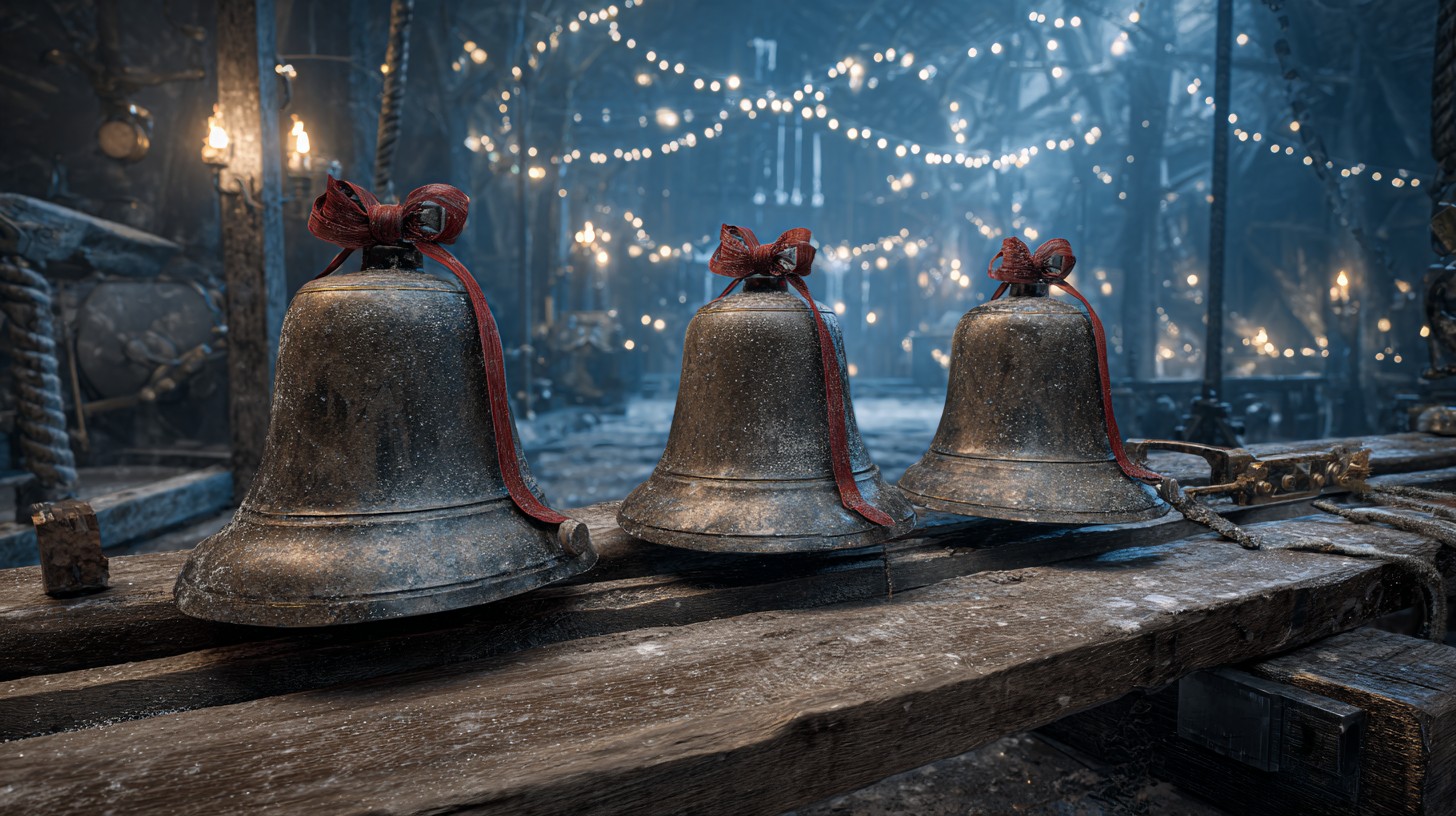
But twenty-seven bells have been returned to the Sleighworks Storage Hall Annex since late spring, each wrapped in red ribbon, each tuned one quarter-step lower than when it vanished, and each carrying a frost spiral under the lip so fine that it can only be seen under polarized snowlight. The bells were not dumped. They were delivered in groups of three, in the order marked on the recovered blueprints’ voice list.
That is not a ransom note. That is a rehearsal schedule.
Timeline Since the Blueprint Break
November 24, 2025: WhistleSleigh reported that the cavern blueprints identified Clink’s unfinished work as a storm-carillon, a weather-calming instrument designed to bind squalls rather than silence winter.
December 18, 2025: Workshop Acoustics began low-amplitude tests using fresh bronze stand-ins instead of relic bells. The first two tests produced nothing except a faint cinnamon smell and one technician’s unhelpful declaration that “the math feels shy.”
January 9, 2026: Snowfall Ridge recorded a sudden quiet pocket during a ridge squall. Sleigh Ops instruments showed wind speed dropping for exactly thirteen seconds along the eastern rope line.
March 2, 2026: The first three missing bells were found on a covered loading bench outside the Sleighworks Storage Hall Annex. No tracks. No lock breach. One frost spiral.
May 31, 2026: The thirteenth interval test was conducted under aurora supervision with Ice Menders standing by at the ridge seam. The old Hold Note, once altered in a frightened hand, did not overload the lantern grid. It hummed.
July 19, 2026: A contact microphone in Whisperwind Caverns captured a voice-like resonance after the test array played the corrected Hold Note. No words are confirmed. Three trained listeners independently transcribed the cadence as: “Not yet. Softer.”
I do not build headlines on haunted dictation. I do, however, underline coincidences until they confess.
Methods and Instrumentation
For this follow-up, we used peppermint-shielded contact microphones, cocoa-insulated recorders, two thermal slates, polarized snowlight, and a borrowed Sleigh Ops ridge anemometer that came with three warning labels and a personal grudge against my left mitten.
Snappers Glitterbeard photographed every returned bell under cross-light. I performed Snowprint Analysis at the Sleighworks Annex, the cavern mouth, and the eastern ridge rope line. Workshop Acoustics supplied frequency maps. The Ice Menders supplied silence, which is what experts provide when they know exactly how bad a mistake could be.
The important part: no test used the original stolen bells at full strength. No public grid lines were connected. No Naughty/Nice scanners, cocoa cauldrons, nursery lanterns, or workshop safety charms were placed on the resonance loop.
The North Pole has had enough magical infrastructure lessons delivered by surprise.
Finding One: Clink Is Returning Bells, Not Hiding Them
The twenty-seven recovered bells came back in nine sets of three. Each set matched a missing interval from the storm-carillon blueprint. Each was placed where Sleighworks staff would find it before morning shift. Each ribbon knot matched the unknown formation first discovered near the sleigh rails, except now the knot included a second loop.
According to Tinsel Archivist Fennel Whimblestitch, the added loop appears in older bellwright shorthand as a custody mark: taken for repair, returned with obligation.
“That is not the knot of a burglar,” Whimblestitch told me, after spreading five rubbings across an archive table and daring anyone to breathe near them. “That is the knot of someone who believes the object has a job to finish.”
I asked whether that made Clink innocent.
“No,” Whimblestitch said. “It makes him complicated. History usually is, unless someone has edited it for children or mayors.”
Finding Two: The Corrected Hold Note Works Only When Played Gently
Last November, the most troubling discovery was the altered Hold Note, a small change in the carillon geometry that could have shunted resonance into lantern circuits and workshop lines. Juniper Quillbit, Maintenance Chief and the North Pole’s most reliable antidote to panic, called the old alteration a fuse installed by someone scared.
Six months of testing suggest she was right.
At high amplitude, even with stand-in bronze, the Hold Note pulls too much energy toward the grid. At low amplitude, it does something stranger and kinder: it teaches the surrounding wind to lower its shoulders.
During the May 31 test, Sleigh Ops measured a thirteen-second smoothing along the eastern rope line. Not a dead calm. Not a weather command. A softening. The kind of change you might miss unless you were watching instruments, ropes, and the faces of old roof beams at the same time.
“This is not a switch,” Quillbit said. “It is a conversation. If we shout, the ridge shouts back. If we hum, it listens.”
I have seen enough machinery to distrust poetry when it comes from engineers. I have also seen enough engineers to know poetry is what they call data after midnight.
Finding Three: The Clefts of Silence Are No Longer Silent
The Clefts of Silence earned their name honestly. Wind enters, sound disappears, and every elf who has ever stood at the rim comes away speaking more softly for an hour.
That changed in January.
Contact microphones placed along the western ice wall recorded faint harmonic tremors after three separate squalls. The tremors match the missing bell frequencies, but not as echoes. Echoes repeat. These answered.
The pattern was simplest on July 19. Workshop Acoustics played the corrected Hold Note for four seconds. Seven seconds later, the cavern returned a low overtone, then a bright third, then a thin upper shimmer that made every recorder frost at the edges. The sequence matched the margin notation from Clink’s ledger: “Ridge listens when Bay takes low.”
This is where the magical thesis begins to look less like romance and more like evidence.
The Two Theses
The mundane thesis: The returned bells and cavern responses are the result of hidden mechanical systems left by Clink or later bellwrights. The storm-carillon may be a forgotten weather instrument with passive resonance chambers built into Snowfall Ridge. Clink’s “presence” could be an acoustic signature, triggered by tests and misread by a nervous town.
The magical thesis: Clink, transformed or preserved by frost magic, is participating in the repair. The returned bells are deliberate cooperation. The “Not yet. Softer.” resonance is not a ghost story for the cocoa line but a boundary set by a craftsman who has learned, painfully, what happens when fear plays too loudly.
My take: the mundane thesis explains the hardware. It does not explain the timing, the custody knots, the returned intervals, or the fact that every bell came back cleaner than it left.
No thief polishes the evidence.
What Santa Authorized
Santa has approved a revised Project Resound plan, now called the Reconciliation Resonance Field Trial. The name is long enough to require its own sleigh, but the protocol is careful.
The plan allows Workshop Acoustics and the Ice Menders to conduct three more low-amplitude tests before the first autumn storm line. The original bells will remain quarantined unless Clink returns the next nine intervals and the ridge seam passes an independent Ice Mender review. Ethics has required public reporting after each test, including any grid flicker, scanner flutter, unexplained lullaby, or suspiciously musical icicle.
“Legends are not excused from accountability,” Santa told me in a statement. “But neither are we excused from listening when a legend is trying to make amends.”
That is the center of the case now. Not whether Clink was frightening. He was. Not whether bells vanished. They did. The question is whether the North Pole can tell the difference between a menace and a repairman who forgot how to knock.
Interim Recommendations
First, residents near Snowfall Ridge should report unexplained bell tones, red ribbon knots, or frost spirals to the NPIB rather than touching them. A frost spiral is beautiful. So is a hot pan. Admire both with restraint.
Second, Sleighworks should keep ECCS, the Echo-Enhanced Candy Chime System, on standby through autumn. The returned bells are promising, but promise does not pass a magical lift inspection by itself.
Third, Project Resound should continue only at low amplitude until the missing plate is recovered. The phrase “Ridge wants the thirteenth” has moved from riddle to operating instruction. No one should pretend the carillon is complete because part of it has begun behaving.
Finally, we should update the public story. Clink was called the Frostbitten Bell Collector because that was the part of him we could see from a distance: the taking, the cold, the silence after the hooks stopped swinging. Up close, under patient light, the evidence shows a bellmaker trying to repair an old mistake without breaking the town he once served.
That does not absolve him. It gives us somewhere to start.
Evidence Plates
Plate 41: Three returned sleigh bells on the Annex bench at first light, red ribbon custody knots intact.
Plate 46: Polarized snowlight revealing frost spiral marks beneath the lip of Bell S-1187.
Plate 52: Contact microphone frost bloom inside Whisperwind Caverns after the corrected Hold Note test.
Plate 57: The eastern ridge rope line during the thirteen-second smoothing event, with Ice Menders visible at the seam.
What Happens Next
If the next nine bells return, Project Resound will attempt a longer rehearsal before the autumn ridge winds begin. If they do not, the field trial pauses. If the missing plate surfaces, this case changes again.
That is the honest state of it: open, warmer than before, and still carrying enough winter in its pockets to deserve respect.
Six months ago, I wrote that Clink had not been hoarding voices. Today I can add this: he may be trying to give them back in tune.
The hidden workshop has not gone quiet. It is listening for us to learn how.
Report sightings, tones, ribbon knots, and suspiciously polite bells to [email protected].