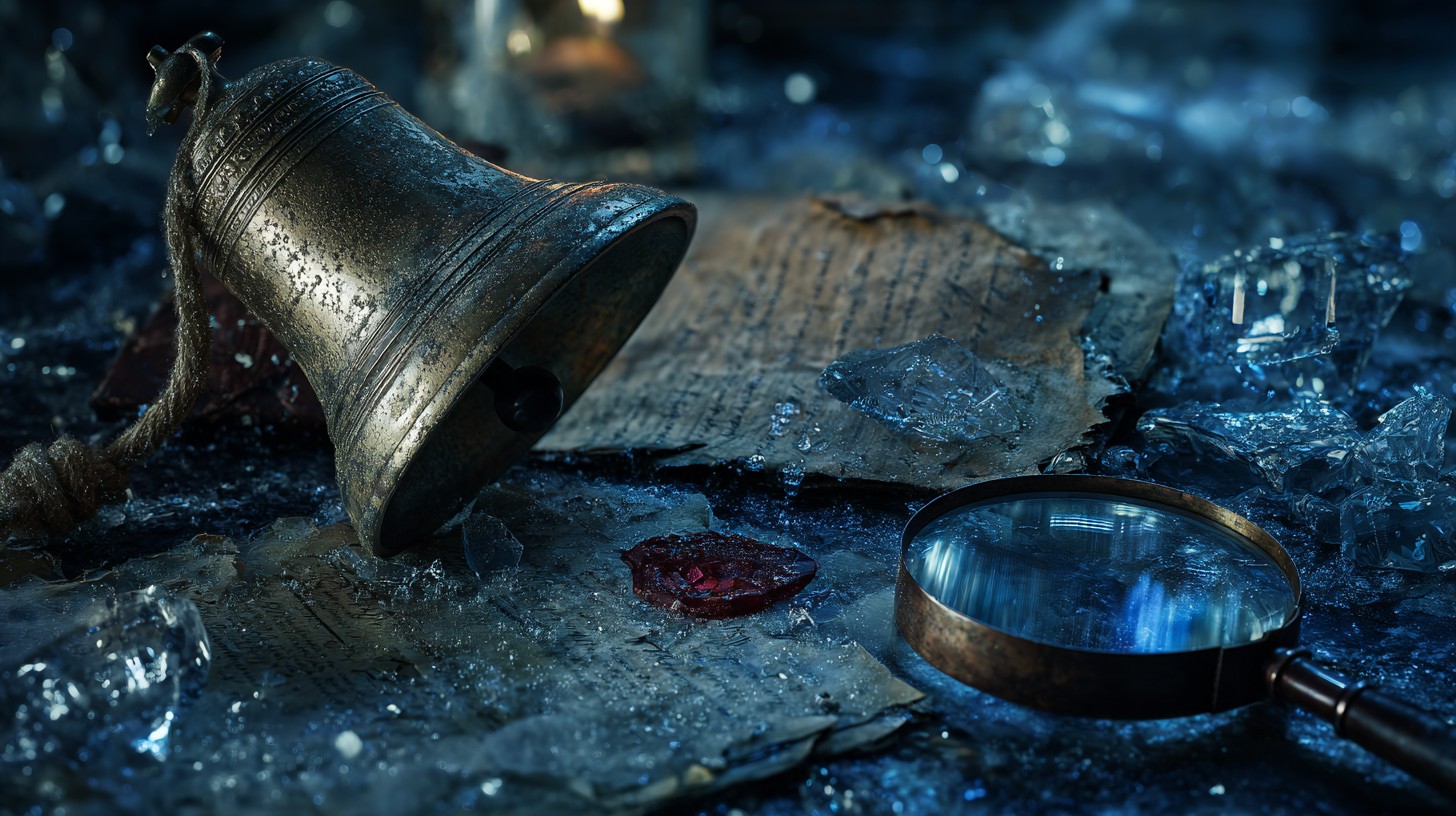
The Legend of Clink, the Frostbitten Bell Collector The oldest stories say you hear him before you see him.
Not a crash of stolen sleigh bells. Not a villain’s laugh rolling down Snowfall Ridge. Just one thin note moving through the storm, so clear it seems to polish the air around it. Then morning comes, a bell hook hangs empty, and a red ribbon knot waits in the frost where no footprint should be.
That is how Clink entered North Pole memory: not as a person, but as an absence.
Long before he became the Frostbitten Bell Collector, the archives suggest he was a bellmaker of unusual skill. His exact name has blurred in the cold. One ledger calls him C. Lenk. Another lists Klinken Frostbell. Both records describe the same kind of work: sleigh bells tuned not only for music, but for purpose. Delivery bells that could carry through blizzard noise. Nursery bells that softened near sleeping children. Wayfinder bells that helped teams hold formation under a hard aurora.
He was not decorating winter. He was teaching sound how to help.
Then came the project that swallowed his life.
Clink began building what the old tales call the Arctic Orchestra: a great array of bells meant to gather many tones into one impossible chord. For years, the story made that sound like vanity, a lonely craftsman trying to build the most beautiful music in the world. But the blueprints we found in Whisperwind Caverns tell a different story. The Arctic Orchestra was a storm-carillon, designed to calm the violent squalls that come down from Snowfall Ridge before they can tear into sleigh lines, workshop roofs, and the roads home.
The legend says a winter wind took his masterpiece. Clink followed it into the snow and never returned. The record is colder and more precise. On the night he vanished, the ridge logged a violent pressure drop. Lantern circuits failed. Sleigh lines iced over. A bell array disappeared from a test stand. Clink was last seen pulling a covered handcart toward Icicle Ridge, carrying listening cones and wearing, according to one witness, “the expression of a person arguing with weather.”
By morning, his workbench was empty. On it lay a red ribbon tied in a knot no one recognized.
Three paces from the door, the first frost spiral appeared.
After that, the story returned once a century. Bells vanished from storage rooms and sleigh rails. Red ribbon knots appeared near empty hooks. Strange tones drifted toward the Clefts of Silence, where wind goes in and echo does not come back cleanly. Parents warned children not to follow bells into snow. Mechanics locked cabinets. Archivists copied the Frostbitten Verse until it became less a poem than a weather report:
“Where jingle fades, and silence grows, He treads where no sleigh ever goes. Return the chime, complete the sound, Or joy shall sleep ’neath frozen ground.”
For years, we read that verse as a threat.
Now I am not so sure. When more than five hundred bells vanished from Sleighworks Storage Hall, the North Pole thought the old menace had returned. I thought so too. The evidence seemed eager to agree: frost spirals, red ribbon knots, tones moving toward the Clefts of Silence. But then we found the hidden workshop inside Whisperwind Caverns.
A thief’s den looks like possession. Clink’s workshop looked like repair.
The bells were arranged by interval, alloy, fracture, and weather function. Damaged bells had been mended. Pure bells were mapped into a larger design. The stolen sound had not been piled up like treasure. It had been sorted like medicine.
That was the turn in the case. Clink had not been gathering bells to end joy. He had been trying to complete the sound.
The blueprints showed a flaw in the storm-carillon’s Hold Note, the part meant to sustain the instrument without overloading the North Pole’s magical grid. Someone, long ago, had altered it in fear. That change may have made the carillon dangerous. It may also explain why Clink disappeared into legend instead of returning to explain himself like a sensible person with a functioning appointment calendar.
This does not excuse him. Bells were taken. Fear was allowed to grow. A community was left with silence where music had been.
But it changes the shape of the story.
Clink frightens us because he crossed a line. He also moves us because the evidence keeps showing a craftsman trapped inside the consequences of one unfinished repair. In recent months, some bells have begun coming back, tied with red ribbon knots that archivists read as a custody mark: returned with obligation. Low, careful tests of the corrected Hold Note have calmed ridge winds for seconds at a time. Once, after a test in Whisperwind Caverns, our microphones caught a faint resonance that three listeners heard the same way:
“Not yet. Softer.” I do not ask readers to believe a ghost gave technical advice through ice.
I ask only that we follow the evidence where it leads.
And right now, it leads to a harder, kinder version of the legend. Clink was a bellmaker. Clink took bells. Clink frightened the North Pole. Clink may also be trying, in the only language left to him, to finish a machine meant to protect us from storms.
The old warning told us to fear the place where jingle fades and silence grows. Perhaps that was never the end of the message. Perhaps the important line was always waiting below it:
Return the chime. Complete the sound.
The legend is not solved. It is becoming legible.
If you hear one clear bell note moving over Snowfall Ridge, do not follow it alone. Mark the time. Tell the NPIB.
Then tell me.
Send WhistleSleigh any reports of humming icicles, storage hooks ringing after midnight, unexplained thaw circles on workbench frost, or old bells sounding a note no one struck: [email protected].